For a first visit, stay in central Sanur between Jalan Pantai Sindhu and Batu Jimbar: the beach, the promenade and the restaurants of Jalan Danau Tamblingan are all a flat walk away. The north end near Sanur Harbour suits early fast boats to Nusa Penida; the south around Mertasari is the quietest and suits families and longer stays. On price, guesthouses run around IDR 300,000–600,000 a night, mid-range hotels around IDR 800,000–1,500,000, and the large beach resorts from about IDR 1,500,000. For four to six people, a three-bedroom private pool villa on the residential lanes behind the beach is usually better value than multiple hotel rooms.
THE SHORT VERSION
Sanur at a glance
- North · the harbour end
- Central · in the middle of it
- South · space and calm
- Resorts · full facilities
- Guesthouses · best value
- Villas · privacy and space
- 3 EN-SUITE BEDROOMS
- PRIVATE POOL PER VILLA
- SLEEPS 6 · 12 WITH BOTH
- DAILY HOUSEKEEPING
- NO CLEANING FEE
- <10 MIN WALK TO THE BEACH
Sanur is compact: one bay, a car-free beach promenade of just over 5 km, and one long main street, Jalan Danau Tamblingan, running parallel behind it. Nowhere in town is truly far from anywhere else, which takes the pressure off the decision. You are choosing an atmosphere, not a commute.
READ MORESHOW LESS
Even so, the ends of the bay feel genuinely different. The north is the working end, with the harbour, the morning boats and the night market. The centre is where the restaurants, the cafés and the long-established hotels cluster. The south is residential, wide and slow, where Sanur's expat families and long-stayers live.
The second decision is the stay type, because Sanur has an unusually wide spread for a town of its size: grand old beach resorts, family-run guesthouses on the lanes, and private villas behind walls. This guide walks the bay north to south first, then compares the three ways to sleep in it.
One thing to know before you read on: we rent out two villas in south Sanur. We have tried to say plainly where the centre or the north end is the better choice for your trip.
What is the best area to stay in Sanur?
Central Sanur, roughly between Jalan Pantai Sindhu and Batu Jimbar, is the best base for a first visit: the beach, the promenade cafés and the restaurants of Jalan Danau Tamblingan are all within a ten-minute walk.
READ MORESHOW LESS
The honest caveat is that in a town this small, 'best area' matters less than it does in Canggu or Seminyak. The promenade is flat and car-free from end to end, taxis and ride-hailing cars are minutes away, and many people cycle everywhere, so you do not need a scooter to stay here at all; our guide to Sanur without a scooter covers what that looks like day to day. Picking the wrong end of Sanur costs you a pleasant fifteen-minute ride, not an evening.
It matters most at the margins: if you are catching a 07:00 boat to Nusa Penida, the north end saves you an early alarm. If you are here for a month with children, the south gives you space and quiet the centre cannot. The next three sections walk the bay from top to bottom.
What is north Sanur like, around Sindhu and the harbour?
The liveliest and most practical end: Sanur Harbour at Matahari Terbit Beach for fast boats to Nusa Penida and Lembongan, the Sindhu night market from about 17:30, and the densest cluster of budget guesthouses in town.
READ MORESHOW LESS
The harbour, rebuilt with a proper pier in late 2022, is the reason many travellers sleep at this end at all: morning boats to the islands leave from roughly 06:30, and walking or taking a two-minute ride beats crossing half of Bali in the dark. The beach at Matahari Terbit is also Sanur's classic sunrise spot, with the jukung outriggers coming in as the sky turns.
Sindhu, just south of the harbour, is the gateway between the working north and the holiday centre: a morning produce market, warungs on the sand, and at night the market's food stalls cooking satay and nasi campur at around IDR 15,000–30,000 a plate. Rooms here are Sanur's best value, though the harbour end can feel more functional than pretty, and boat-day mornings start noisily early.
What is central Sanur like, around Batu Jimbar?
The postcard version of Sanur: tree-lined beach at Segara Ayu and Sindhu, the restaurant strip of Jalan Danau Tamblingan a block inland, and the hotels that made the town's name, from the sprawling Hyatt Regency gardens to Tandjung Sari, Bali's first boutique hotel, open since 1962.
READ MORESHOW LESS
This is where most first-time visitors are happiest. Breakfast happens on the promenade, dinner on Tamblingan, and the beach in between is the easy, swimmable middle stretch of the bay. Cafe Batu Jimbar, the long-running institution that gives the neighbourhood its shorthand name, is a good marker: if your bed is within ten minutes of it, you are central.
The trade-off is predictable: this is also where prices peak and where July, August and the Christmas weeks feel busiest. 'Busy' remains relative, Sanur has no clubs and the town winds down before 22:00, but if you came for silence, keep reading south.
What is south Sanur like, around Semawang and Mertasari?
The quietest end: residential lanes, a handful of larger resorts, and the widest, most open stretch of beach at Mertasari, where the wind arrives in the dry season and brings the kitesurfers and, in July and August, the big traditional kites flown along this coast.
READ MORESHOW LESS
South Sanur is where the town's long-stayers and expat families settle, and it shows in the fabric: proper houses behind walls, small local cafés, space between things. The beach is broader and breezier than the centre, better for walking and kite-watching than for the calmest swimming.
Stay here if you value calm over convenience, are settling in for weeks rather than days, or simply like being at the quiet end of a quiet town. The centre is still only a short cycle up the promenade, and that ride, flat, car-free and along the water, is one of the genuine pleasures of staying south.
Should you book a resort, a guesthouse or a villa in Sanur?
It comes down to group size and how you spend the evening. Couples who want a spa, a gym and breakfast handled choose a resort. Solo travellers and budget couples do well in guesthouses. Families and groups of four or more usually get more space, more privacy and better value from a private villa.
READ MORESHOW LESS
The resorts are Sanur's heritage act and they do facilities properly: the renovated Hyatt Regency in its nine hectares of gardens, the village-styled Andaz next door, Maya Sanur under its green roof on Tamblingan. Expect from about IDR 1,500,000 a night at the entry level and considerably more in high season, with pools, kids' clubs and breakfast in the price. Everything, though, is shared, and a room is still a room: there is nowhere private to sit together once the day ends.
Guesthouses are the town's best-kept bargain, at around IDR 300,000–600,000 a night for a clean fan- or AC-cooled room, often around a small pool, usually run by the family who live there. They suit travellers who are out all day and want little more than a good bed and a good breakfast.
A villa flips the arithmetic for groups. Six people in a hotel means three rooms and no shared space that is not public; in a three-bedroom villa it means one booking, a kitchen, a living room and a pool that belongs to you for the week. From about four people the total often undercuts the hotel equivalent. Longer stays tilt the same way: after a week, a kitchen stops being an extra and becomes the difference between a holiday and eating out twice a day.
What should you check before booking a villa in Sanur?
Whether it is genuinely private or a unit in a shared complex, whether housekeeping is included, whether there is a cleaning fee, the real walking time to the beach, and who answers if something breaks at nine in the evening.
READ MORESHOW LESS
'Private pool villa' is used loosely. Some are one unit in a larger compound with a shared entrance and a plunge pool; others are standalone houses behind their own gate. Both can be good, but they are different products, and the photographs rarely make it obvious. Ask directly how many bookings share the compound.
Distances deserve the same scepticism everywhere in Sanur: 'close to the beach' can mean a five-minute stroll or a twenty-minute march in the heat with a bag of towels. Ask for the walking time, not the kilometres, and check which stretch of the bay it lands on, because the beach at Mertasari and the beach at Sindhu are different mornings.
Frequently asked questions
Is Sanur expensive to stay in?
No, by Bali resort-town standards it is good value: guesthouses at around IDR 300,000–600,000 a night, mid-range hotels around IDR 800,000–1,500,000, and large beach resorts from about IDR 1,500,000. Eating out is cheaper than Seminyak or Canggu too.
Should you stay near Sanur Harbour for the Nusa Penida boat?
Only if you are catching the earliest boats regularly. The first fast boats leave from about 06:30, so sleeping at the north end saves an alarm, but the whole town is within about ten minutes of the harbour by car, so any Sanur base works for a normal departure.
Is a private pool villa in Sanur worth it?
For a family or a group, often yes: a three-bedroom villa usually costs less than the equivalent hotel rooms, gives everyone an en-suite bedroom, and adds a kitchen, shared living space and a pool nobody else uses. For one or two travellers who want a spa, a gym and breakfast included, a resort may suit better.
“The communications were fantastic. The villa was perfect for our three generation holiday. It was clean, well set up and had everything we needed. Getting transport was easy, but it was also an easy walk to the Main Street. The staff responded immediately to any concern, checking if it was ok for them to clean and always keeping our water full.”
Where Oasis fits in
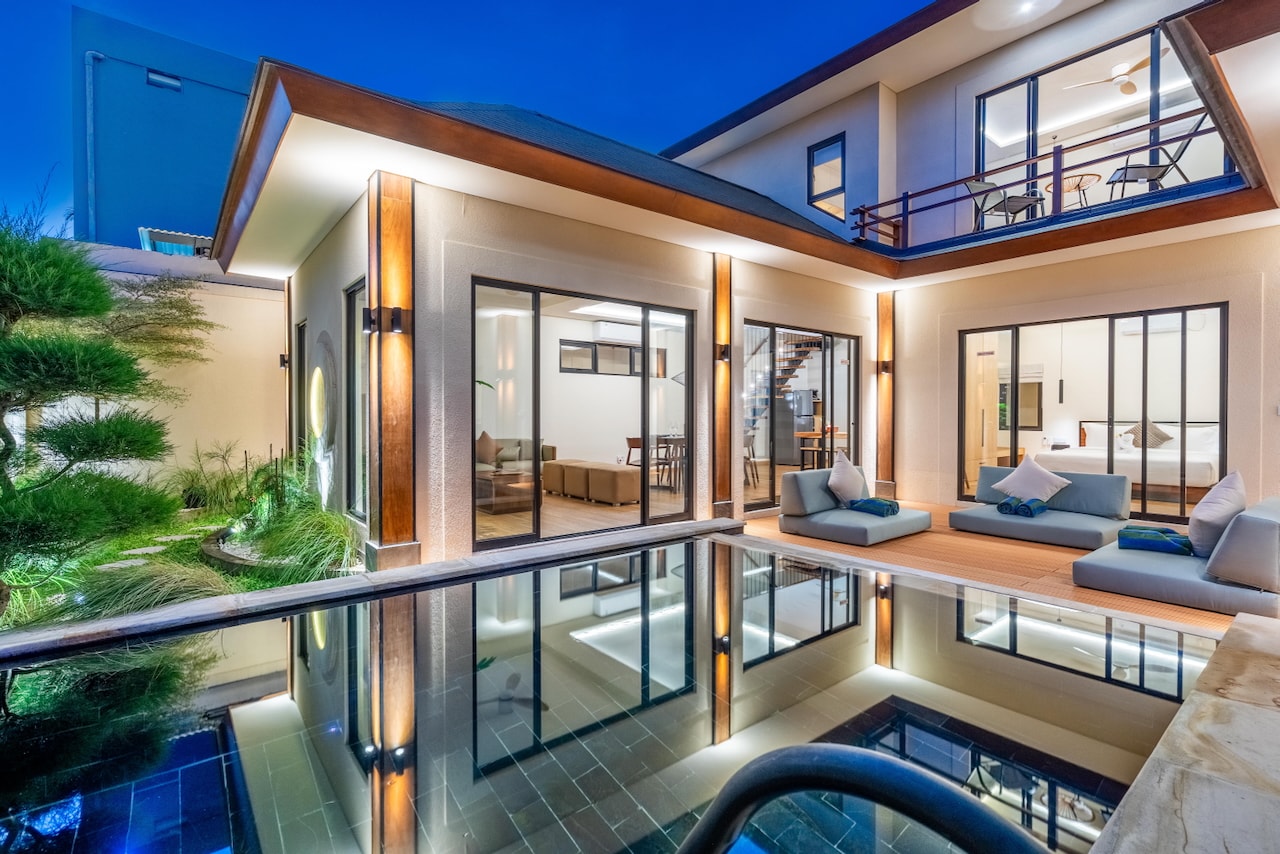
How Oasis Residences fits the map
Oasis Residences sits on a quiet gated lane on Sanur's residential side, less than ten minutes' walk from the beach and five from the cafés and restaurants. Each of the two identical villas is designed around its own private pool, with natural stone, warm teak and glass connecting the living spaces to the water, three en-suite bedrooms and room for six guests. Daily housekeeping and concierge service are included, and there is no cleaning fee. For larger groups, the identical neighbouring villa raises the total to six bedrooms and twelve guests behind one shared gate.