Sanur is warm all year, roughly 25–30°C. The dry season runs April to October; from November to March showers are usually short and fall in the afternoon, with January the wettest month at around 300 mm. July, August and the year-end holidays are the busiest and priciest; September to February is quieter and generally the best value, and April to June and September to October combine dry weather with smaller crowds. Kitesurfers come for the June to September trade winds. One date needs planning around: Nyepi, Bali's Day of Silence, falls on 9 March in 2027 and closes the whole island, airport included, for twenty-four hours.
THE SHORT VERSION
Sanur through the year
- April–June
- July–August
- September–October
- November–December
- Year-end holidays
- January–March
- 25–30°C ALL YEAR
- DRY: APRIL–OCTOBER
- SHOWERS: NOV–MARCH
- BUSIEST: JULY, AUGUST & YEAR-END
- BEST VALUE: SEPT–FEBRUARY
- KITE WINDS: JUNE–SEPT
- NYEPI 2027: 9 MARCH
Bali does not really have a bad season, which is why the question is harder than it looks. There is no cold, the sea stays warm, and even in the wettest months the sun is out for most of the day. What changes is the rhythm: how much rain falls and when, how many people are here, and what a villa costs.
READ MORESHOW LESS
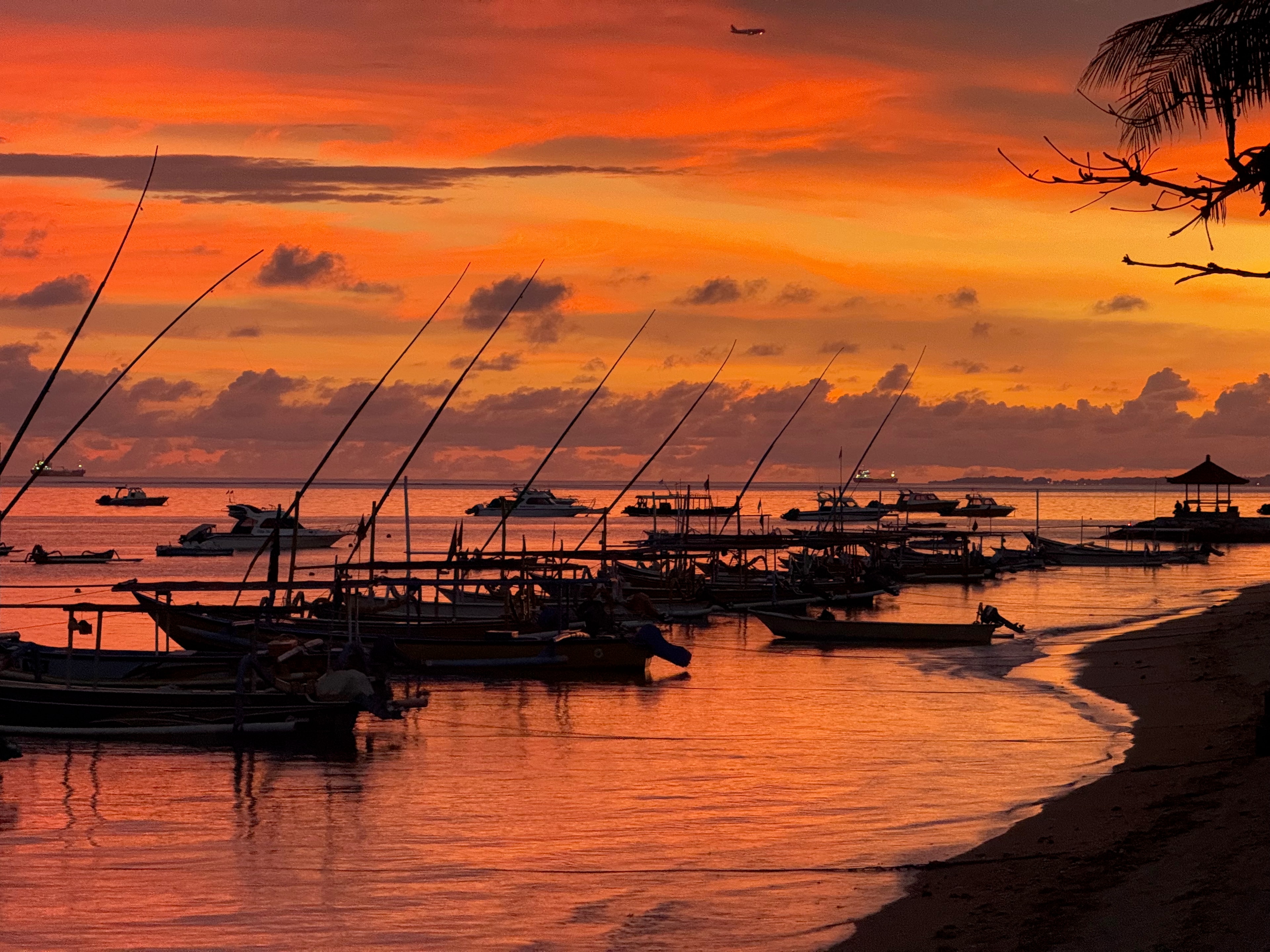
Sanur has a particular advantage in this. The town faces east, so the day opens over the water, and in the wet season the mornings are frequently clear even when the afternoon is not. A rain shower here tends to be an hour on the terrace with a book, not a lost day.
This page sets out the seasons as they actually feel, which months suit which kind of trip, and the dates that genuinely need planning around.
What is the weather like in Sanur, and when is the rainy season?
Warm and humid all year, roughly 25–30°C. The dry season runs from April to October; the rainy season is November to March, when short tropical showers fall mostly in the afternoon and January is the wettest month at around 300 mm.
READ MORESHOW LESS
The numbers make the contrast plain: January, the wettest month, brings around 300 mm of rain in the Sanur and Denpasar area, while August manages around 40 mm. But the word to hold on to is 'showers'. Wet-season rain in Bali is generally heavy and brief rather than grey and all-day: it arrives, it empties, and then the air is clean and the light is extraordinary. Mornings are often the driest part of the day, which suits a town that already does its best work before ten.
Humidity is the more constant factor. It is high year-round, which is why shade, a pool and air conditioning matter more here than a temperature figure suggests. The sea barely changes at all: around 27°C in the coolest months and 29°C at its warmest, so swimming is never in question.
Which months are the busiest in Sanur?
July and August, and the weeks around Christmas and New Year. Those are also the months when accommodation is most expensive and books out furthest ahead.
READ MORESHOW LESS
Two quieter waves are worth knowing about too. Indonesian school holidays in late June and early July add domestic travellers to the start of the peak, and the Idul Fitri holiday week, which moves with the Islamic calendar, briefly fills hotels and roads with domestic visitors wherever it lands: in 2027 it is expected in early March, pending the official moon sighting.
If your dates are fixed to a school holiday, the advice is simply to book early: the year-end period in particular fills months in advance, and a minimum stay of five nights applies at Oasis Residences over the Christmas and New Year weeks.
Sanur is calmer than Bali's west-coast towns even at peak, so 'busy' here means the restaurants are full and the promenade is lively, not that you cannot find space on the beach.
When is the best value time to visit?
September to February is quieter and generally the best value, with the year-end holidays as the obvious exception. January to March is the cheapest and emptiest stretch of all.
READ MORESHOW LESS
The trade-off is honest: those quiet months are the wet ones. If your holiday depends on eight uninterrupted hours of sun a day, they are not for you. If it depends on swimming, eating well, sleeping properly and having the beach nearly to yourself, they are excellent, and the sea is at its warmest in exactly those months.
You see the rate for your exact dates at the checkout before you pay. Book one villa (up to 6 guests) or both (up to 12) online, for up to 21 nights. Staying longer, or planning something unusual? Ask in the chat; if it cannot answer, it gives you the owner's details.
When is the kitesurfing season in Sanur?
Roughly June to September, when the south-east trade winds blow across the reef; June to August is the most reliable stretch, typically 12–20 knots in the afternoon.
READ MORESHOW LESS
The launch is Mertasari Beach at Sanur's southern end, a short ride down the coast from the main beach, and it is one of Bali's friendlier spots to learn: the wind comes onshore and the reef keeps the inside water flat, so schools set up on the sand through the season. Watch the kites fill the sky on a windy July afternoon and you will see why this stretch has its own following.
Outside those months the wind is too light or too fitful to count on, so if kitesurfing is the point of the trip, aim for June to August. For everyone else the wind is barely noticeable: a pleasant afternoon breeze off the water on the warmest days of the year.
When is Nyepi in 2027, and does it affect a stay?
Nyepi is Bali's Day of Silence, falling in March each year as the date moves with the Balinese Saka calendar; in 2027 it is Tuesday 9 March. For twenty-four hours, 6 am to 6 am, the whole island stops: the airport closes, no traffic moves, nobody goes outside, and lights stay low after dark.
READ MORESHOW LESS
It is genuinely unlike anything else in the world, and travellers who plan for it often say it was the best day of the trip. But it has to be planned for: you cannot arrive or leave on Nyepi, and you stay on the property for the full day, so a villa with its own pool, kitchen and garden is a very different experience of it than a hotel room.
The evening before is the opposite of silent: the ogoh-ogoh parades, with enormous demon effigies carried through the streets to drums and firecrackers. In 2027 that falls on 8 March, and with the Idul Fitri holiday expected the same week, early March 2027 will be a busier travel window than March usually is. If your dates are anywhere near March, check exactly when Nyepi falls before you book flights.
Does the season change what there is to do?
A little. The dry months bring the calmest sea and the clearest water for snorkelling and boat trips to the Nusa islands; the wet months trade some of that for empty beaches and the greenest rice terraces.
READ MORESHOW LESS
Fast-boat crossings to Nusa Penida and Nusa Lembongan are weather-dependent all year: sailings change with conditions, and no operator should promise otherwise. In the wet season it is worth keeping a day trip flexible rather than fixing it to your last morning.
The reef keeps the swimming in the bay calm in every season, which is the point of Sanur: the water is the one thing that does not have a bad month. What changes the swimming more than the season is the tide; our Sanur beach guide explains when to go in and which stretch to pick.
Frequently asked questions
What is the best month to visit Sanur, Bali?
For dry weather with smaller crowds, April to June and September to October are the strongest months. July and August are the driest but also the busiest and priciest.
Is Sanur worth visiting in the wet season?
Yes, if you accept the trade-off. The sea is warm, the beach is quiet, the rates are the lowest of the year, and rain tends to arrive in short heavy bursts rather than lasting all day.
When should I book for July, August or Christmas?
As far ahead as you can. Those are the months that sell out first, and over the Christmas and New Year weeks there is a minimum stay of five nights.
“Upstairs bathroom is luxurious and massive! All bedrooms come with en-suite bathrooms!”
Where Oasis fits in
Any month, the same villa
Oasis Residences works in every season: air conditioning throughout, a private pool in a walled garden, a covered terrace for the afternoon shower and a fully equipped kitchen for the days you would rather not go out. Book one villa (up to 6 guests) or both (up to 12) online, for up to 21 nights. Staying longer, or planning something unusual? Ask in the chat; if it cannot answer, it gives you the owner's details.