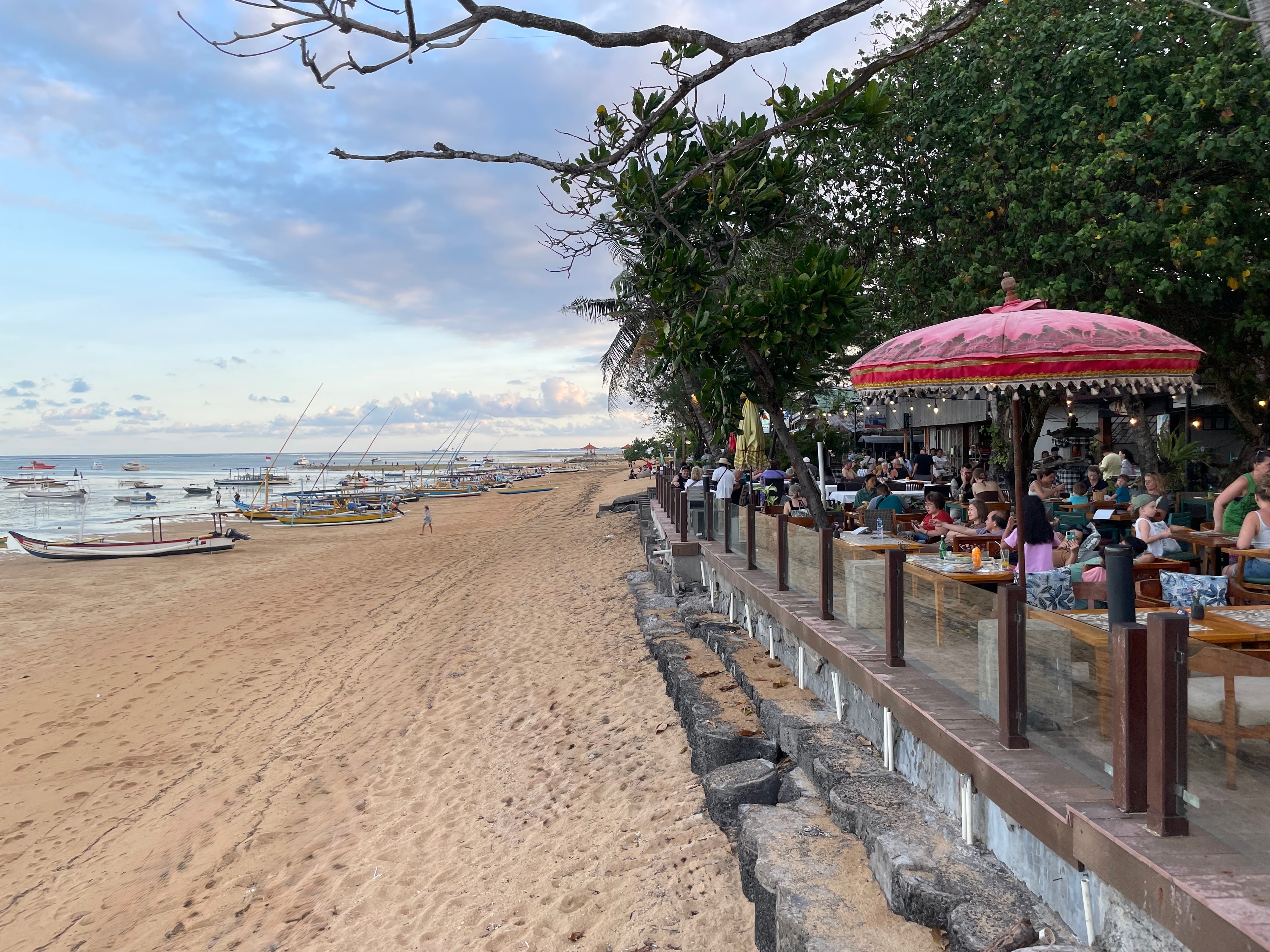
Yes, Sanur is one of the easiest places in Bali for a family holiday. An offshore reef keeps the sea calm and shallow-entry along the whole bay, a paved car-free promenade runs for around 5 km along the sand, and the airport is only 25–30 minutes away in normal traffic. Restaurants, pharmacies, a modern mall with a cinema and an international hospital all sit within a short radius, so the everyday logistics of travelling with children mostly take care of themselves.
WHY IT WORKS
What makes Sanur easier with children
- Calm, shallow-entry water
- A 5 km car-free promenade
- Flat, short distances
- Restaurants used to children
- Practicalities nearby
- 25–30 minutes from the airport
- REEF-PROTECTED SEA
- 5 KM CAR-FREE PROMENADE
- FLAT & PRAM-FRIENDLY
- 25–30 MIN FROM AIRPORT
- BABY COT & HIGH CHAIR ON REQUEST
- SLEEPS 6 PER VILLA
Most of what makes a family trip hard has nothing to do with the destination's highlights. It is the getting there: the transfer that takes two hours, the beach with a shore break, the pavement that stops halfway, the restaurant twenty minutes away by scooter. Sanur quietly removes most of that.
READ MORESHOW LESS
The reef is the first reason. It runs the length of the bay and takes the force out of the ocean, so the water inside is calm and enters gradually rather than dropping away: the conditions parents actually look for. The second reason is the promenade: around 5 km of paved, car-free path along the beach, from Jalan Hang Tuah in the north to Mertasari in the south, that works equally well for a pram, a six-year-old on a bicycle and a grandparent who would rather not deal with traffic.
The third is simply density. Restaurants, cafés, pharmacies, a supermarket and the beach itself are all close together, so an afternoon does not have to be planned around a single outing. Very little in Bali is this compact.
Is Sanur good for families with children?
Yes, it is one of Bali's easiest family bases, because it lowers the daily effort. The sea is calm rather than surf, the ground is flat, the distances are short, and the things a family needs during a day (food, shade, a pharmacy, a toilet, a taxi) are all close together.
READ MORESHOW LESS
Bali's more famous beach areas are built around surf and nightlife, which are exactly the two things that make a trip with young children harder: waves that knock toddlers over, pavements that vanish, and long stretches of road between anything. Sanur was never built around either, so what remains is a beach town that works at the pace of a five-year-old.
It also suits families with a wide age range. A trip where the grandparents, the parents and the children all want different things is far easier in a place where all of it happens within walking distance, and none of it needs a scooter: walking, bicycles, taxis and ride-hailing cover a family day here, as our guide to Sanur without a scooter sets out. If you are still weighing bases, our comparison of Sanur against Canggu, Seminyak and Nusa Dua goes through this trade-off honestly.
Is the sea at Sanur safe for children to swim in?
The bay is calm and shallow-entry because of the offshore reef, which is why Sanur has a long reputation as a family swimming beach. The tide matters though: swimming is best in the hours around high tide, and children should always be supervised in the water.
READ MORESHOW LESS
Sanur's tide moves a long way. Around high tide the water is deep enough to swim along much of the beach; at low tide it retreats far out, exposing broad shallow flats that can be rocky or weedy in places: fine for paddling, hunting crabs and starfish-spotting, less good for an actual swim. Checking a tide app the night before and planning the beach morning around it is the single most useful Sanur habit a family can pick up. Reef shoes are worth packing for everyone.
Sanur has no lifeguard service along every stretch of beach, so treat it as you would any unpatrolled water: stay with your children, and keep to the calmer, sandier sections you have already walked. For the full picture of the tides and which stretch suits small swimmers, see our Sanur beach guide.
What is there for children to do in Sanur?
Beach mornings, cycling the promenade, kayaks and paddleboards on the flat water, kite flying at Mertasari, the night market, a sea turtle centre one island over, and fast-boat day trips for older kids.
READ MORESHOW LESS
Cycling is the daily ritual for most families here. Rental shops sit all along the promenade and charge around IDR 30,000–50,000 a day for a standard bicycle, usually cash, with child seats and smaller frames available at the more established shops. Our concierge arranges bicycles on request, including sizes for children.
On the water, the calm bay is where many children first stand up on a paddleboard: SUP and kayak rental runs around IDR 100,000–200,000 an hour from operators on the beach. At the southern end, Mertasari's open lawns fill with kites, especially around July and August when the winds are steady, and vendors sell simple ones on the spot.
In the evening, the Sindhu Night Market is a genuine hit with kids: from about 17:30 the morning market transforms into food stalls where a plate of satay or nasi goreng costs around IDR 30,000. Bring small cash notes. And a short drive south on Serangan, the Turtle Conservation and Education Centre shows rescued sea turtles up close: entry is free, with a donation of around IDR 50,000–100,000 encouraged.
For a change of scene, fast boats run from Sanur Harbour to Nusa Lembongan and Nusa Penida in around 30–45 minutes, from roughly IDR 150,000–250,000 one way. It is a brilliant day out with school-age children, but a long one with toddlers, so plan one trip and leave space around it.
Which part of Sanur is best for families?
Central Sanur, roughly between Jalan Hang Tuah and Jalan Duyung, is the sweet spot for most families: the beach, the promenade and the restaurant strip along Jalan Danau Tamblingan are all within a few minutes' walk.
READ MORESHOW LESS
The north end, around the rebuilt Sanur Harbour, is handiest for an early fast boat but busier with boat traffic and arrivals. The south, around Semawang and Mertasari, is the quietest stretch: wide lawns, kite flyers and local families at the weekend, with a slightly longer walk to the main run of restaurants.
The quiet lanes one or two streets back from the beach are where Sanur's villas sit, and they are often the best of both: you lose the sound of the beach cafés at night and still reach the sand in under ten minutes on foot with a child in tow.
What should parents plan for in Sanur?
Sun, tides and small cash. The equatorial sun is strongest in the middle of the day, the sea swims best around high tide, and markets and bike rentals mostly run on cash.
READ MORESHOW LESS
Rash tops and hats earn their place in the luggage: shade on the beach comes from trees and rented umbrellas rather than continuous cover, and the midday sun this close to the equator is stronger than it feels. Mosquito repellent for the evenings is standard Bali practice, especially in the wetter months from November to March.
The practical safety net is unusually good for a beach town: pharmacies sit along Jalan Danau Tamblingan, there is a supermarket in the centre, and Bali International Hospital is a few minutes away by car. Most families never need any of it, but knowing it is there changes how relaxed a trip feels.
One thing Sanur will not give you: waves. Older kids who want to learn to surf will need a day trip west, and teenagers hunting beach clubs will find Sanur's evenings gentle. That is the trade, and for most families with young children it is exactly the right one.
Why does a private villa work well for a family?
Because a villa gives you the two things a hotel room cannot: a shared living space where the family can be together, and a pool that is not shared with anyone else.
READ MORESHOW LESS
With children, a hotel evening usually ends the moment the youngest goes to bed: everyone else moves to the balcony or a whisper. In a villa, bedrooms are separate from the living space, so the evening continues.
A kitchen matters too. Breakfast at your own table, milk in the fridge, snacks that do not require going out, and the ability to cook something plain when someone has had enough of eating out.
The arithmetic often helps as well: for a family of five or six, one villa is frequently comparable to, or less than, two or three hotel rooms, with more space and no cleaning fee.
Frequently asked questions
Is Sanur or Nusa Dua better for a family trip to Bali?
Both have calm, reef-protected water, so the difference is what surrounds it. Nusa Dua is a planned resort enclave where the hotel is the holiday: manicured, secure and quiet, but with little everyday Balinese life within walking distance, so dinner outside the resorts usually means a taxi. Sanur is a real town, so the children walk with you to warungs, markets, the promenade and the beach, which is why families who want villa space and local life tend to prefer it.
What can kids do in Sanur on a rainy day?
The Icon Bali mall has a Cinema XXI with an IMAX screen and indoor play areas, all air-conditioned. Rain in Sanur also tends to fall in short bursts rather than all day, so a villa pool afternoon usually survives the wet season.
“Super quick communication, and very clean and comfy beds and sofa. Kitchen was well equipped and location was in a quiet street yet close to the beach. Highly recommend!”
Where Oasis fits in
A family villa in Sanur with its own pool
At Oasis Residences, each villa sleeps up to six guests in three en-suite bedrooms and has its own private pool, on a quiet gated lane less than a ten-minute walk from the beach. Two neighbouring villas can accommodate up to twelve guests for larger or multi-generational families. A baby cot and high chair are available on request. The pool is 170 cm deep and unfenced, and a fence cannot be arranged, so young children need an adult with them around the water.