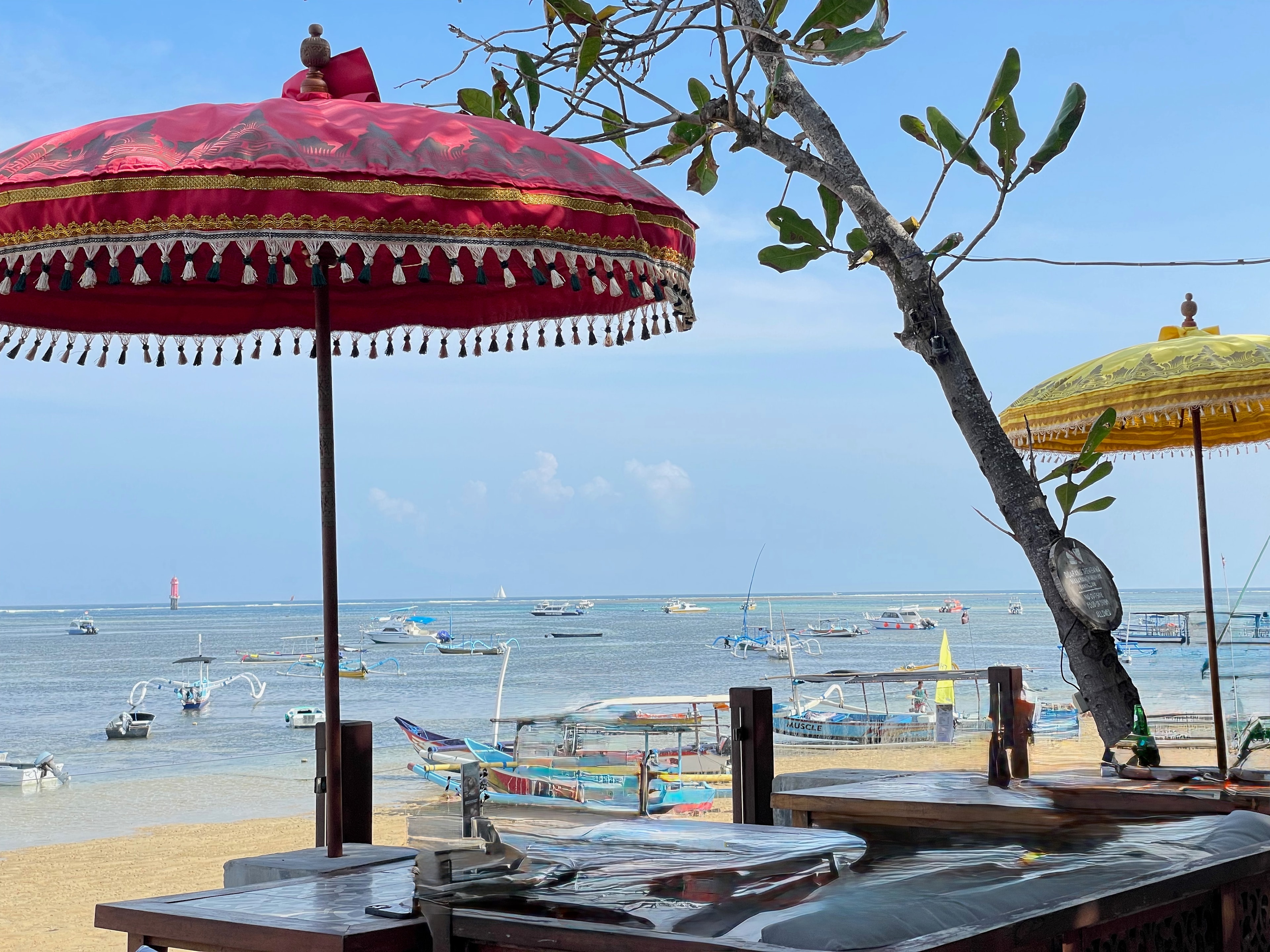
Yes, you can swim at Sanur Beach, and it is one of Bali's calmest places to do it: an offshore reef takes the swell, so the bay behind it stays flat with a gradual, shallow entry that suits children and cautious swimmers. The catch is the tide. Around high tide you can swim along most of the bay; at low tide the water retreats a long way and leaves shallow reef flats that are for walking, not swimming. Sanur Beach is really a chain of named stretches, from Matahari Terbit by the harbour in the north to open, kite-filled Mertasari in the south, linked by a paved, car-free promenade of just over 5 km.
THE BASICS
What Sanur's beach is like
- Protected by a reef
- Calm and shallow-entry
- Tide-dependent
- Six named stretches
- Sunrise, not sunset
- A promenade, not a road
- REEF-PROTECTED BAY
- SHALLOW ENTRY
- CHECK THE TIDE
- SIX NAMED STRETCHES
- SUNRISE COAST
- 5 KM CAR-FREE PROMENADE
Sanur's beach does not behave like the beaches Bali is famous for. There is no shore break, no rip pulling along the sand, and no surfers waiting beyond it. What there is instead is a wide, shallow bay held behind a reef: calm, warm, and completely dependent on the tide for how it feels on any given afternoon.
READ MORESHOW LESS
That is the single most useful thing to know before you arrive. Nobody is disappointed by Sanur's water once they understand it; people are only disappointed when they walk down at low tide expecting to swim and find themselves ankle-deep a hundred metres out.
This guide covers why the sea is calm here, how the tide changes the day, which stretch of the beach is which, and an honest answer to whether Sanur Beach is actually nice.
Are there waves at Sanur Beach?
Very few inside the bay. A reef sits offshore, running roughly parallel to the coast, so waves break out there rather than on the beach and the water inside stays flat.
READ MORESHOW LESS
This is a genuine geographic difference, not a marketing line. Bali's west and south coasts face the open Indian Ocean swell, which is exactly why the surfing there is good. Sanur faces east across a strait, with a reef in front of it, so the same island produces two completely different kinds of beach.
The practical consequence: swimming in Sanur is a calm, flat-water experience. The only surf is out on the reef itself, at breaks like the one off the Hyatt at the bay's southern end, reached by board rather than by wading in. If you want to learn to surf on a beach break, you will need to travel to the other side of the island for the day.
How much does the tide matter at Sanur Beach?
A lot. Around mid to high tide you can swim comfortably along much of the beach; at low tide the water retreats a long way and leaves broad shallow flats, some of them rocky, weedy or coral-strewn.
READ MORESHOW LESS
The simplest habit is to look up the day's tide times when you arrive and plan swims around the higher water. Tide times shift by roughly an hour each day, so a morning swim one day becomes a midday swim a few days later. Any tide app or forecast site covers Sanur, and hotel activity desks along the beach post the day's times.
Low tide is not wasted time. It is when the flats are best for walking, for children hunting crabs and shells, and for photographs of the boats sitting on the sand. Reef shoes make it far more comfortable, because parts of the exposed flats are sharp underfoot.
Conditions also vary along the bay: some stretches are sandier and hold swimmable water longer, others turn to flats sooner. It is worth walking a little before choosing your spot on the first day.
Which part of Sanur Beach is best?
It depends what you want: Sanur Beach is a chain of named beaches along one bay, and they feel different enough that picking the right one matters. Sindhu and Segara Ayu in the centre are the easiest for loungers, cafés and swimming, Karang suits families, Matahari Terbit in the north is the sunrise and harbour end, and Mertasari in the south is open and windy.
READ MORESHOW LESS
Matahari Terbit, at the northern end, means "sunrise" and lives up to it: it is the classic dawn spot, popular with local families at weekends. It also sits beside Sanur's harbour, open since late 2022, so this is where the fast boats to Nusa Penida and Nusa Lembongan come and go, and the busiest, most functional end of the bay.
Segara Ayu and Sindhu are the central, easy-going stretches: tree-lined sand, warungs and cafés right on the path, and the Sindhu night market a short walk inland. If you just want to drop onto a lounger and swim at high tide, this middle section is the simplest choice.
Karang is the family favourite, with shallow water, swings and the much-photographed pavilion at the end of its short pier. Semawang, next along, is quieter and more residential. Mertasari, at the southern end, is the widest and most open: this is where the wind arrives in the dry season, bringing kitesurfers and, in July and August, the big traditional kites flown along this coast. The Bali Kite Festival itself is traditionally held around Padang Galak, just north of Sanur; check the dates locally.
Is Sanur Beach nice?
Yes, for what it is: a calm, golden-sand bay with a car-free promenade of just over 5 km, built for swimming at high tide, walking, families and long slow mornings. It is not a dramatic white-sand postcard beach, and it never pretends to be.
READ MORESHOW LESS
The honest downsides first. The sand is golden-grey rather than white, low tide leaves flats that can look muddy and strand seaweed along the waterline, and after rain or big tides the crews rake the beach for a reason. Sunset happens behind the town, not over the water. If your dream Bali beach is turquoise surf and orange sunsets, Sanur will feel wrong.
What Sanur does better than almost anywhere on the island is everything around the swimming: a flat, car-free promenade you can walk or cycle for an hour without touching a road, loungers under the trees for around IDR 50,000–150,000 a day for two with a parasol, and cafés where the sand meets the path. It is a beach for using every day, not for photographing once.
What else can you do at Sanur Beach?
Watch the sunrise, walk or cycle the promenade, take a kayak or paddleboard out on the flat water, join a snorkelling trip to the reef, or simply eat where the sand meets the path.
READ MORESHOW LESS
Sunrise is the beach's best hour, and one of the genuine reasons to stay in Sanur rather than visit it. The jukung outriggers come in, the promenade fills with runners and walkers, and the water is at its stillest, all before the heat.
The calm water also makes Sanur one of the easier places in Bali to try stand-up paddleboarding for the first time; rentals and lessons run from several points along the beach, typically in one- or two-hour sessions. Snorkelling is honest work off the sand, so take a boat trip out to the reef instead, where the coral and the visibility are.
In the windy months, roughly June to September, the southern end of the bay fills with kites: kitesurfers at Mertasari, and in high season the enormous handmade kites of the Bali Kite Festival, traditionally held around Padang Galak at the northern edge of Sanur in July or August. Check the dates locally, and time a stay around it if you can.
Frequently asked questions
Can you swim at Sanur Beach?
Yes. An offshore reef removes most of the open-ocean swell, so the bay is calm and shallow-entry. The experience depends heavily on the tide: mid to high tide is the swimming window, while low tide leaves flats too shallow to swim.
Is Sanur Beach sandy or rocky?
Both, depending where you stand and when. Much of the beach is golden-grey sand, but low tide exposes broad shallow flats that can be rocky, weedy or coral-strewn in places. Reef shoes are useful.
Is there a lifeguard at Sanur Beach?
Not along every stretch. Treat the water as unpatrolled: swim where you can see the bottom, keep children with you, and take conditions on the day at face value.
Is Sanur Beach good for snorkelling?
The best snorkelling is out at the reef rather than off the sand, and boat trips run from the beach. Conditions and visibility vary with tide and weather.
Is Sanur better for sunrise or sunset?
Sunrise. Sanur faces east, so dawn over the jukung boats is the beach's signature hour; sunset happens behind the town rather than over the water.
“Upstairs bathroom is luxurious and massive! All bedrooms come with en-suite bathrooms!”
Where Oasis fits in
Ten minutes' walk from the sand
The beach's best hours are early and late, which only really works if you can walk there. Oasis Residences sits on a quiet gated lane less than a ten-minute walk from Sanur Beach, so sunrise and the last soft hour of light stop being outings and simply become part of the day, with your own private pool for the hard midday sun in between. Each villa has three en-suite bedrooms, and beach and pool towels are provided.